
Death
Every culture has relied on those who are willing to stand at the threshold between life and death, tending to the emotional and communal needs of the living.

Welcome,
Today marks day twenty-nine of Field Notes on Archetypal Patterns. Today is the last day of field notes and archetypal patterns… I found it fitting to write about death.
Let’s begin with an excerpt from my new book Esoterica: The Shadow Worker’s Codex:
“While writing my dissertation on psychopathy and the human shadow, it become clear that a part of me was at risk due to the intense, graphic, and disturbing nature of the content I had to expose myself to.
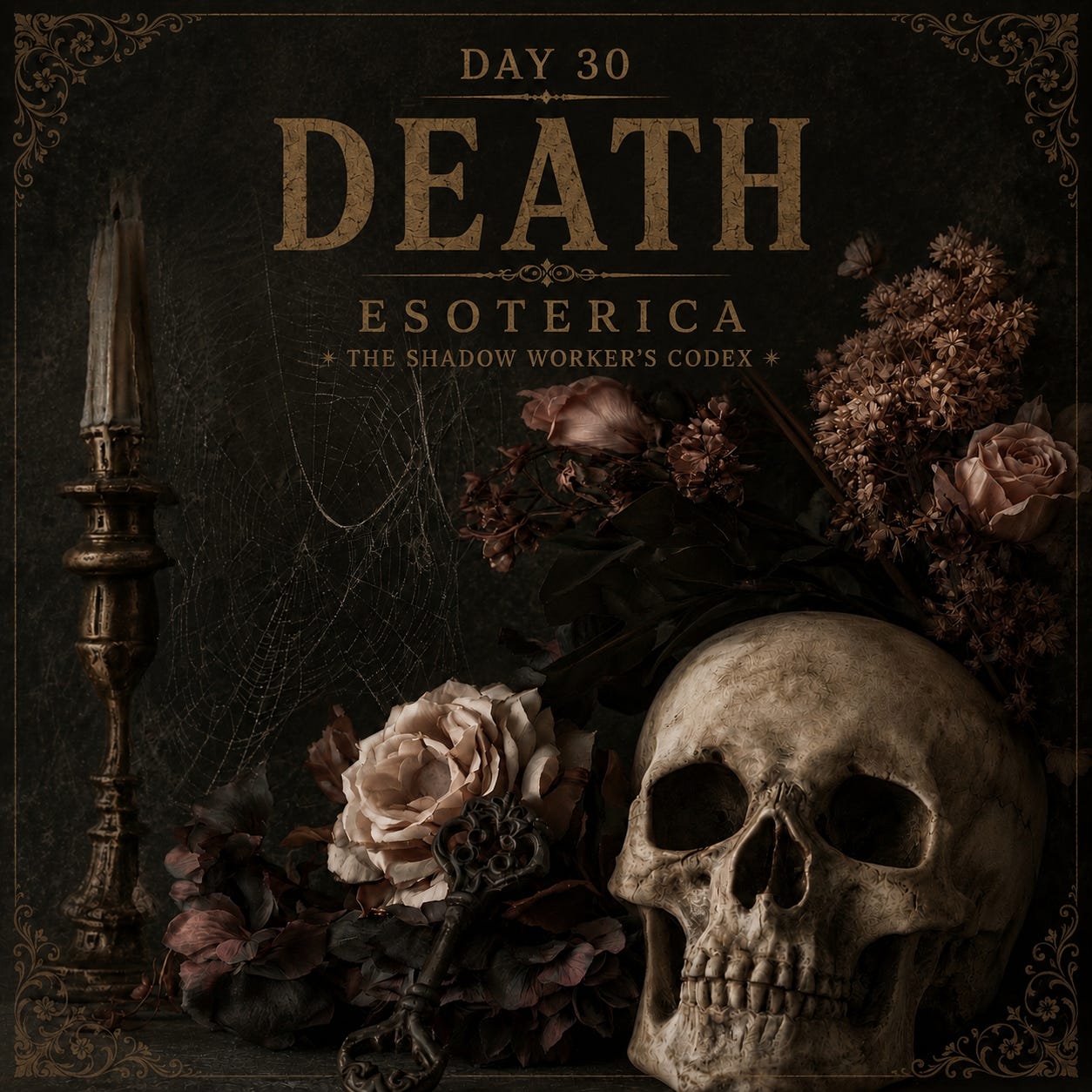
For this reason, my intuition prompted me to create a death altar, a small area for intentional items. On my altar I have one item that represents what needs to die. This item can be a stone, a charm, a crystal, something from nature, or whatever I feel called to work with at that time.
Then, I have one talisman that acts like an anchor to the timeless, eternal part of me, who I am beneath at my core. This second object is more of a tether to this world when things get dark or when the material, I am working with feels too heavy. It’s as an anchor to the soulful self, a reminder of continuity as I shapeshift my identity around the darker parts of the human psyche.
This allows me to feel grounded and safe while engaging in difficult or tragic cases, client experiences, and research. Your death altar once again does not need to be for this same reason, but a reminder to allow life to unfold, while releasing what no longer serves.
The altar is a physical space that anchors us here, while also engaging with the divine of our understanding as we navigate change and transitional phases of life. The death altar can change with a season, such as from fall into winter, or with the shift of a specific time you are moving through.”
— Dr. Melissa Kim Corter
On my altar, I have one item that represents what needs to die during a deep process. I have used a stone, a charm, a crystal, something from nature, or whatever I’ve felt called to work with.
Then, I have one talisman that acts like an anchor to the timeless, eternal soul of who I am beneath these dying, shedding layers. This second object is more of a tether to this world when things get dark or when it feels like we may never move out of this phase.
It’s an anchor to the self, a reminder of continuity when we experience a profound shift in identity, in our faith, or in something else that is coming undone and being stripped away.
I place an item that keeps me tethered to the truth of my soul and allows me to grieve what is beginning to fall away. Something as simple as two candles side by side, intentionally placed in an area that feels right.
I choose an object such as a stone, crystal, necklace, candle, or other meaningful talisman to represent who I am, a soulful self beneath it all. Then I place one object that represents the part of myself that is dying, that I am grieving, letting go of, and putting to rest.
This practice is done with compassion. I’m not trying to get rid of this part of myself. I’m embracing it more completely, putting it to rest with firm boundaries. It no longer gets to operate in the same way as it did before... and I will now commit to this gesture, diligently working to change the pattern without slipping back into the old way.
Archetypal Pattern: Death
The death altar is not only a physical space we set up with intentionality. It may be a crime scene, the bed we surrender to in illness, the location where we have that last exhale, the final place we inhabit the body before we transition.
In 2025, I became a certified medicolegal death investigator (MDI). The role requires the investigation of deaths that are sudden, unexpected, violent, unattended, suspicious, or occur under suspicious circumstances. The MDI works alongside medical examiners, coroners, law enforcement, and forensic pathologists.
I am not active in this role; it was something I had wanted to do for years, more so as a researcher and someone who wanted to work in criminal justice throughout my life.
The training includes specialized education in forensic science, pathology, anatomy, injury interpretation, evidence preservation, scene documentation, legal procedures, and ethical standards.
They are also responsible for notifying the next of kin.
I learned a great deal about death on a physical level and the toll it takes on first responders and others who are involved in death work. I also gained a deeper appreciation for how to hold space without bringing emotions into the situation, keeping things clear for the sake of loved ones.
This part of my work is more research-oriented; I combine that with psychological and archetypal patterns.
My respect for the dead is one of the reasons I no longer shy away from my passion for justice. I used to fear people’s opinions about my interest in the criminal mind, darkness, the shadow, and psychopathology.
I have studied these things closely, and it is not a love of death that drives my curiosity; it is my trust in the infinite intelligence that lives within us and our life experiences… including the ones we struggle to understand.
Working with loss and tragedy taught me how to hold difficult complexity differently, and in doing so, I have deepened my awareness of death and transition. It helped me recognize the impact my presence can have on someone as they move through one of the worst moments of their life.
There is a tendency to offer wisdom, comfort, and understanding… but grief does not ask us for those things. When we share our loss as a response to sharing someone else’s pain, we are not listening to them. We are stealing the space that could help them feel held by the moment, by our need to show we care.
It’s selfish, and trust me, I know how helpless we can feel in those moments. Someone is grieving, and we just want to take their pain away… But who are we to do that? We can help them tremendously by listening rather than trying to fill the space.
Death is not only about the physical; the ego also goes through a death. One version of ego death I covered in this series was the dark night of the soul. The many layers of who we think we are continue to shift throughout a lifetime.
The death of what was is sometimes a deeper integration of these identifications. The roles we hold and the things we believe, just like the seasons, some die as others are reborn.
Sometimes we spiritualize these experiences, which can feel as if we are minimizing the toll they take. To give up a layer of oneself, to see it die and wither, can bring about gut-wrenching grief.
I once witnessed this happen to a young woman who had mapped out her life and had one plan for her future. In her eyes, it was the only thing she wanted.
When that dream came to a screeching halt, she didn’t just fall apart; she grieved that life as if it were a loved one taken too soon. It still pains her to speak of the details; the death of that dream has her stuck in between lives. Her health soon tanked, and she lost her faith.
This is serious stuff; an ego death, or the loss of an identity, can feel like a soul-crushing experience. Some people will not come back from it; it takes more than a part of them, and they lose something essential of themselves.
Call it soul; whatever it is, it is clear when that type of death passes through life.
I think of this as the undertaking… the undertaker originally had nothing to do with death or working with the dead. It came from the English word “undertake,” meaning to take upon oneself, to assume responsibility for, or to carry out a task.
The verb traces back to the Old English “undertacan,” a combination of “under” and “tacan” (“to take”), and described a person who accepted an important duty or obligation.
By the late seventeenth and eighteenth centuries, the term had gradually come to be associated with death because those who organized funerals began to describe themselves as undertakers.
They ‘undertook’ every aspect of caring for the deceased and arranging the burial, from preparing the body and supplying a coffin to coordinating the funeral procession, working with churches and cemeteries, and overseeing the countless practical details that accompany a person’s death.
Their role extended beyond caring for the body; they assumed responsibility for guiding families through one of life’s most difficult transitions. The title became prominent during the Victorian era, when elaborate mourning customs turned funeral arranging into a specialized profession.
Victorian undertakers became iconic figures, wearing black frock coats, waistcoats, and top hats. They organized funerals, but they were also caretakers of ritual and tradition. As funeral practices became more professionalized, newer titles such as mortician and funeral director emerged.
These names reflected a growing emphasis on professional training, science, and compassionate service, but the word “undertaker” gradually took on an old-fashioned or even ominous quality.
The original meaning of the word carries symbolic depth. It’s a sacred act to have those who are willing to accept difficult burdens that others cannot or will not carry.
The undertaker represents the ones who accompany others across thresholds of change. Every culture has relied on those who are willing to stand at the threshold between life and death, tending to the emotional and communal needs of the living.
Paid subscribers receive bonus content for further reflection and exploration below this line.
